Translate

Monday, 22 April 2013

Designers can't just think about themselves!


   When I produce a design at work I have many people to think about. Firstly the client, will they understand the design and recognise any benefits within it. Drawings for a client proposal may differ greatly from the drawings I produce for manufacture. A design for a client may have rendered images showing a more realistic view of the finished product. I may only include overall dimensions of the design. Descriptive comment within the drawing maybe more explanatory of the design. A client proposal must be clear and will be visually much different from the more technical drawings produced for manufacture. 

   Once a design has been signed off by a client another set of drawings is needed for manufacture. While rendered images look great they do not hold the correct information for our factory to make a component. There are several different people along the line of production and I must think about their individual processes and make sure the relevant information they will need is clear.

   Often the first process is the laser cutting of the flat part profiles from a sheet of material. For our laser operators I need to mark the material on stock to be used in manufacture. If there is any etching I must point this out. If the material is sensitive to poor handling I must make sure they are aware of this. They will also require the material specification. We work with various grades of steel and alloys; 403,304 and 316 stainless steel.  6082 and 1050 aluminium. CR4, S275 and S355 steel. This information must be clearly described on production drawings or the incorrect material may be used making for a costly mistake. De-burring requirements must be clearly stated and on the actual Laser nest we make sure the operators are aware of any changes to what we recognise as a standard nest. For instance we normally work with a 10mm minimum border around the edge of sheet steel. This can be reduced to 1mm but the laser must be switched to accurate sheet edge detection. The laser will take longer to initiate but as you might have guessed is more accurate on initial sheet recognition and we can squeeze an extra part on. If this is not pointed out it could lead to loss of parts.

    The second group of people I may have to consider when producing drawings are the press brake operators. Do my drawings have all the dimensions they need? Fold line dimensions and bend extents. Overall dimensions and information on the bend radius used so they can match this with tooling in order to produce the piece correctly. Which side is the good side and any relevant tolerances they are required to work to.

   The third set is the fabricators. Here I must detail any welding criteria. If it’s a stitch weld how long are the stitches and at what interval. Maybe the unit needs to be gas tight, maybe no welds are to be visible from one side. Should the fabricator use TIG welding or will a faster MIG weld be sufficient. Again what tolerances are they to work too? Can we laser etch any components to make construction easier?  Will the fabricator require a separate JIG to be made for a job? Are there any holes to be tapped out? If so what thread and to what depth?  Countersinking all these details must be clear or the fabricators will come knocking on the design office door. If in doubt as a designer ask the fabricator. It is easy to draw on 3D programs but it can be much more difficult or even impossible to actually make the component the way it has been designed.
  
  The fourth group are the powder coating people. Colour requirements need to be included, if a specific RAL colour is to be used this needs to be clear along with the finish, satin or gloss. Smooth or textured. Are there any holes or threads that need to be masked up prior to coating? Once coated, should the product be wrapped or palletised for delivery?

   In my design role I feel it is necessary to understand manufacturing processes. If a design is created in a way that streamlines these processes it already has an edge on cost. Working in design is challenging but very rewarding. I have many people to consider whilst carrying out my daily duties, but the more I consider them the more respect I earn and the smoother a job will run. My goals with each contract completed are a satisfied customer and a happy workforce and with careful consideration of all the parties involved this can be achieved.


Thursday, 11 April 2013

Monochrome


   Black and white, dark and bright using shades and stark contrast monochrome can offer some interesting results. 
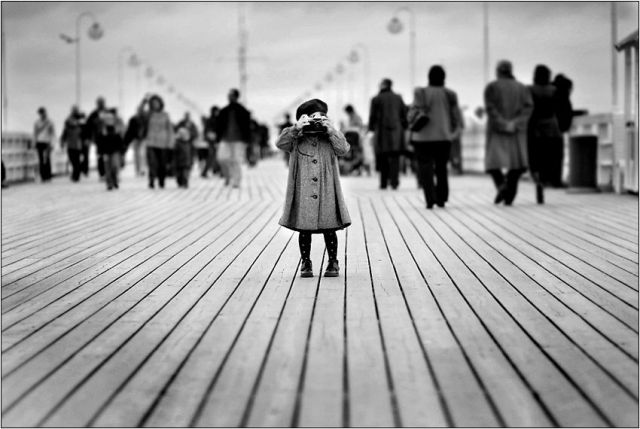
   Today it is possible to apply filters to digital photographs and choose if we would like an image in colour, black and white or monochrome.  But this is only a recent development. All images were black and white not so long ago. At times black and white fits perfectly. This photo of a child taking a photo of the person taking her photo is a great example. Complemented by perfect focus length the image draws in your attention. Questions arise, was it taken a long time ago? Shes not holding a modern digital camera but I think the woman's handbag in the background isn't from the early 1900's either. The little girl is dressed classically, a hoody would give the game away. Even the decking and location, a pier hints at Victorianism perhaps. Clever use of monochrome can evoke a sense of age within images.


   Sometimes in design the contrast available when using a monochrome scheme will be intentional. Often kitchens and bathrooms are a popular choice.


   Irregular shapes work well in this shop interior alongside the monochrome scheme. It puts emphasis on the shapes and nicely divides the area up. The bright lights add to the contrast. The clothing is hung, light clothes on black, dark on white making them stand out against the two backgrounds.


   This photo of trees in snowy surroundings is naturally monochrome, but in ways has visual similarities to the shop image above. The monochrome shop creates an avenue of cloths much like the trees focusing our attention deep into the image. In both we are undistracted by colour.

   Although most of us perhaps would assume monochrome means simply back and white or greyscale. Monochrome can be an image made of a single colour or shades of a single colour.


   Producing work in a monochromatic format under the right circumstances can amplify the impact of the piece and is always worth considering. 
   The model I mentioned in my blog will be monochromatic, it will be all white. For an architectural model this works well because it provides a blank canvas for inspiration. If I made the model with colour I think it could hinder creative thoughts and design suggestions. Instead of looking at a blank canvas you would see all the decay and litter. The vandalism on the site, over grown trees and damp conditions. If you looked at a model with all this detail the creative ideas you are seeking for the project would be swamped by the visual impact of a semi derelict site. 
   Using monochrome can be visually stark, but it can be attention grabbing and purposeful use of monochrome can simplify some work and images if that is the goal.


Black and white image of girl with camera[online image] Available at<:http://img.izismile.com/img/img2/20090916/black_and_white_photographs_22.jpg> [Accessed April11 2013]
Black and white bathroom image [online image] Available at<:http://www.sigmaenterijeri.rs/img/proizvodi/kupatilski%20namestaj/11.jpg> [Accessed April 10 2013]
Black and white shop interior image [online image] Available at<:http://www.designmena.com/wp-content/uploads/2013/03/CM8015668@cartel38-600x400.jpg>[Accessed April 10 2013]
Black and white tree image [online image] Available at<:http://www.canvas101.co.uk/images/gallery-art/Photographer/Sunny%20Kalsi/SK0010%20black%20and%20white%20trees%20f.jpg>[Accessed April 10 2013]
Pink Monochrome image [online image]Available at<:http://www.bigblackpig.com/painting/monochrome2.jpg>[Accessed April 10 2013]


Tuesday, 9 April 2013

Model Making

   For one of my projects I am making an architectural scale model of the National Picture Theatre in Hull, England. For this I need a few things.
   I have gathered and been given plans, drawings, photos, sketch up models and more.  Details on how the building/ruin stands today and how it originally looked. 


Present day frontage
Inside today


 The Theatre today looks very different to its heyday and has been slowly crumbling with the passing years. This may soon change as plans are afoot to renovate the Theatre. A memorial garden, an education centre, exhibitions and displays about Hull and its wartime history. There are many ideas being floated.
  
  The Theatre suffered damage still visible today on the night of March 17/18 1941. At around 10pm the air raid warnings sounded. The audience, who had been watching  Charlie Chaplins " The Great Dictator " of all films! quickly took shelter and when a bomb hit the Theatre everyone escaped unharmed. The Theatre however suffered heavy damage and was never to be repaired. The owner simply built a new one further down the road. 
Original Theatre Plans.
A useful sketch for making a model showing the surrounding buildings
     I have detailed information of the site as it was and is now. So a scale model will be easy right?
    I am going to construct the model using foam board. A foam core product with smooth white paper on each side. It's rigid and comes in 3mm 5mm or 10mm thicknesses. Great for model building and not over priced. I am going to use 5mm for my model. 

   I will also need a very sharp knife, a steel ruler, scale ruler and some foam glue. I intend to make an aluminium base for the model at work and will have it powder coated RAL 9003 Signal White. I will also make a little laser cut plaque with the building information, scale details and I might just sneak my name on the corner too!
Foam Board
   So all I need now is patience and persistence and it should come together nicely. I will post some interim images of construction so pop back when you have a few mins to see how its going. 
   In the meantime if you would like some more information on the National Picture Theatre in Hull please go to http://www.ncww2mt.freewebspace.com/ 


   National Picture Theatre Frontage Image [online image]Available at:<http://www.arthurlloyd.co.uk/Hull/NationalPictureTheatreHull2011/NationalPictureTheatreHull1.jpg> [Accessed April 9 2013]

National Picture Theatre Interior Image[online image]Available at:<http://i.thisis.co.uk/275561/gallery/images/3341168/2001110.jpg>
[Accessed April 9 2013]

Foam Board Image[online image]Available at<:http://www.artdiscount.co.uk/images/product/white_foam_board1258362837_1121317985054_407.jpg>[Accessed April 9 2013]

All other images sourced from existing project information.